
AI Homework Helper: How to Use One to Actually Learn (Not Cheat)
An AI homework helper is a study tool that walks you through a problem step by step so you understand how to solve the next one yourself — not a machine that hands you an answer to copy. Used the honest way, it works like a patient tutor at 11 p.m.: it explains the concept, shows the reasoning behind each step, and quizzes you until it clicks.

That’s the promise of a good study AI app — it’s built to make you better at the subject, not just faster at finishing tonight’s worksheet. This guide covers how to get real understanding out of one, where the line to academic dishonesty sits, and what to check before you rely on it for an exam.
What an AI Homework Helper Actually Is
An AI homework helper is a type of AI study assistant built on a large language model — the same family of technology behind GPT, Gemini, and Claude. You type or upload a question — text, a photo of a worksheet, or a PDF — and it returns a worked solution with the reasoning spelled out, usually in seconds. It’s a modern descendant of what researchers call the «intelligent tutoring system«: software designed to adapt explanations to an individual learner rather than deliver one static answer key to everyone.
The tutor, not the answer key
The best AI homework help tools are built around explanation, not extraction. Ask a question and a good tool doesn’t just output a number — it names the concept being tested, breaks the solution into steps, and tells you why each step follows from the last. That’s the difference between homework AI worth using and a plain calculator with extra steps: a calculator gets you through tonight’s problem set; an explanation gets you through the exam that doesn’t allow the tool at all.
What it is not
It is not an «answer machine» meant for pasting homework into and copying the output. The value is in the explanation, not the final number. A tool that only spits out answers makes you worse at the test, because you never practiced the reasoning yourself. A tool that explains — and then checks whether you actually absorbed it — makes you better, which is the entire point of using an AI tutor in the first place.
How It Works, Step by Step
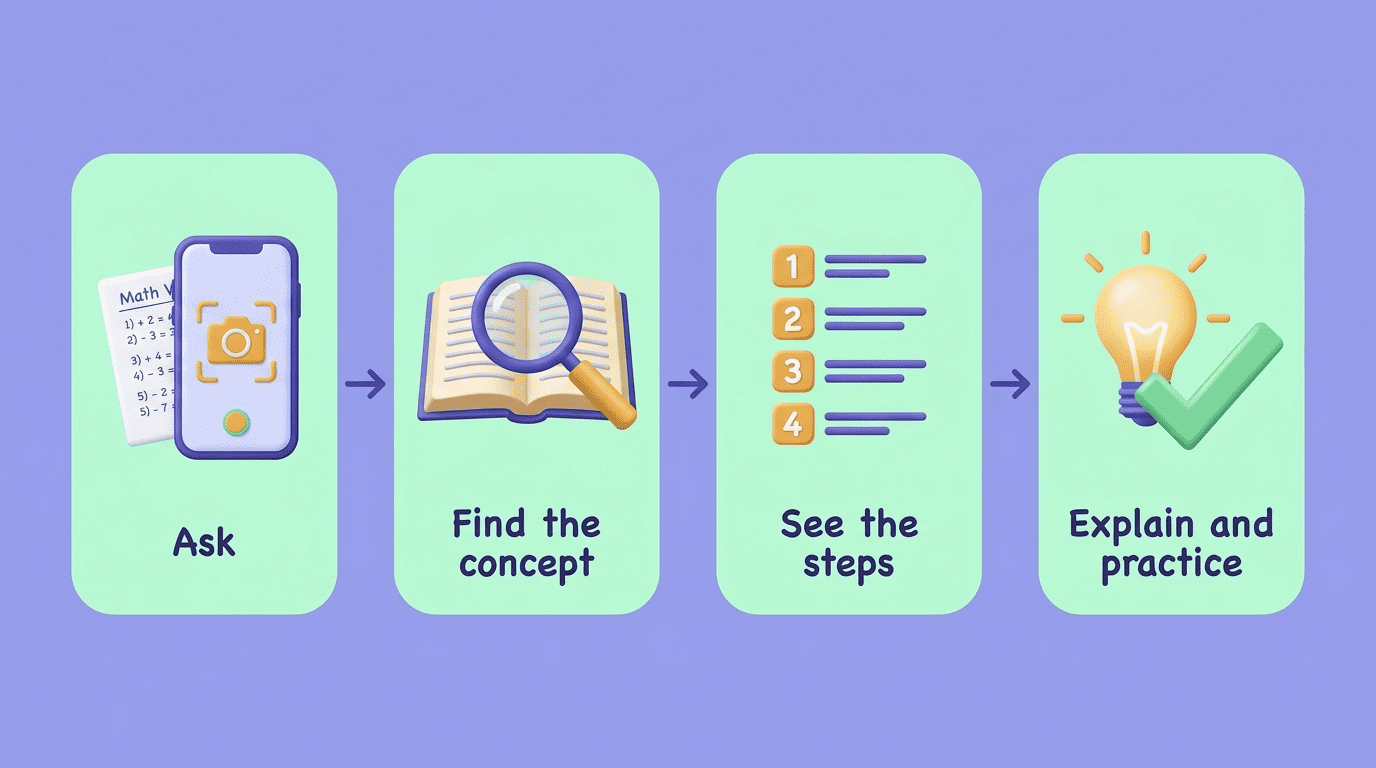
Most AI homework solvers follow the same basic loop, regardless of which model runs underneath. Understanding that loop is what turns a homework helper from a shortcut into an actual study session.
- Submit the problem. Type it, paste it, or upload a photo, scan, PDF, or even audio of the question.
- The tool identifies the concept. It recognizes what’s being tested — a quadratic equation, a titration calculation, a thesis-statement problem — before it starts solving.
- It shows the full solution path. Every intermediate step is shown, not just the final result.
- It explains each step in plain language. This is the part a plain search engine or calculator skips entirely.
- It generates a similar practice problem. A genuinely useful AI homework helper lets you test whether the explanation actually stuck.
Top tools now cover 40+ disciplines and accept multiple input formats, which matters because homework rarely arrives as clean typed text — it’s a photo of a textbook page or a scanned worksheet more often than not.
The quality of what you get back depends heavily on how you ask:
- «Just give me the answer» gets you a number you’ll forget by the next class.
- «Explain why step 3 works, and give me a similar problem to try on my own» gets you a skill you’ll still have at exam time.
The Honest-Use Line: Learning vs. Cheating
This is the part that separates a study tool worth trusting from one that sets students up to fail — and it’s worth being direct about it.
Where the line is
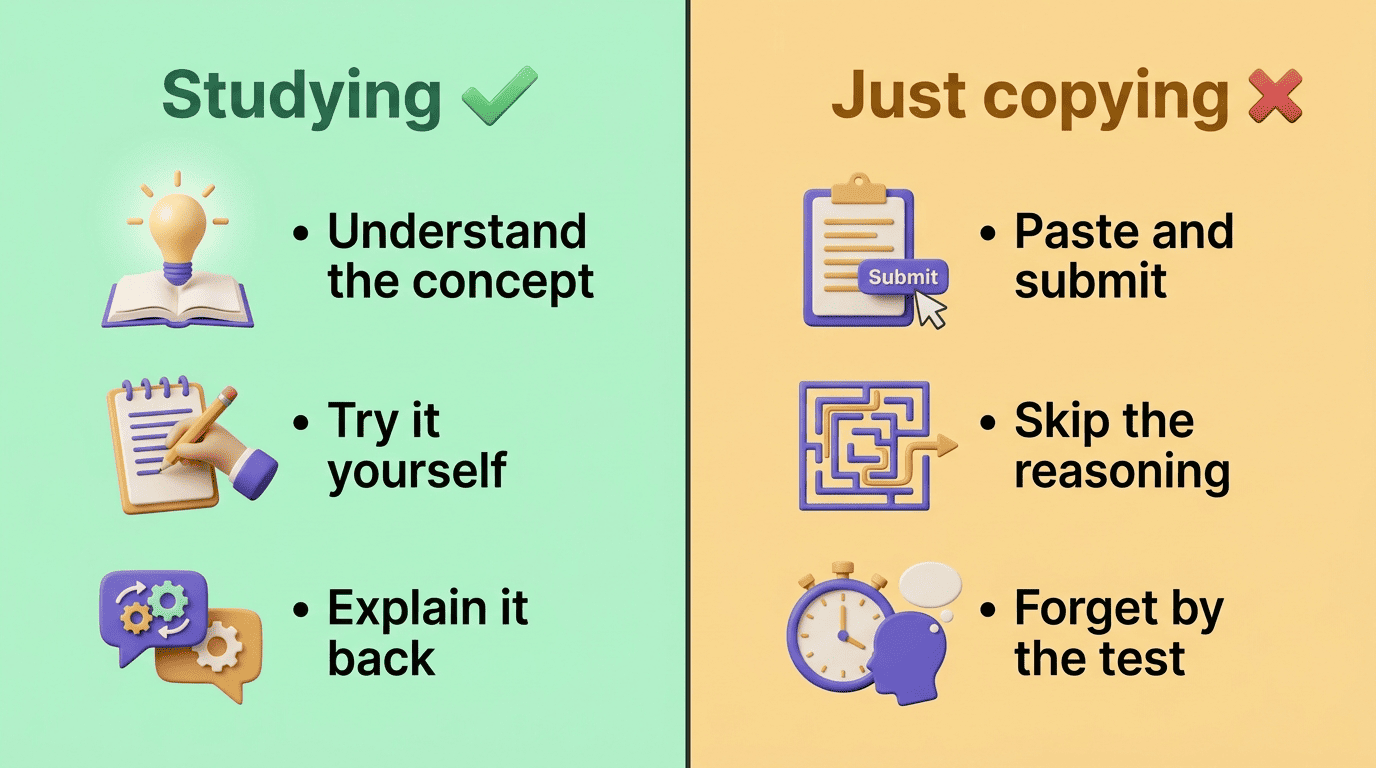
Using a study AI homework helper to understand a concept, check your own reasoning, or prep for a test is studying. Submitting AI-generated work as your own — turning in an explanation you didn’t actually absorb, or an essay you didn’t write — is academic dishonesty, in the same category as copying a classmate’s paper.
ICAI defines academic integrity as a commitment to six fundamental values: honesty, trust, fairness, respect, responsibility, and courage.
International Center for Academic Integrity
The U.S. Department of Education’s Office of Educational Technology has made a similar point about classroom AI use generally: its report on AI in teaching and learning recommends keeping humans «in the loop,» so the tool supports a student’s own thinking rather than replacing it. That’s the standard worth holding any AI homework helper to — including this one.
A simple self-check
Here’s a rule of thumb that works across nearly every subject: if you could explain your answer to your teacher with the tool closed, you learned it. If you couldn’t, you copied it. Academic-integrity policies differ by school and even by instructor, so treat this as a starting point, not a substitute for reading your syllabus. A few things worth doing every time:
- Read the explanation before you look at the final answer, not after.
- Try the follow-up practice problem without reopening the tool.
- Check your school’s specific AI policy — some allow it for practice only, others restrict it entirely on graded work.
- When in doubt, ask the instructor directly rather than guessing.
What Subjects and Homework It Handles
A wide-coverage AI homework helper is only useful if it actually understands the subject you’re stuck on — and «good use» looks different depending on what that subject is.
Math and calculus. The value here is checking your work step by step, not generating the final number — the tool should catch exactly where your algebra or your derivative went wrong.
Physics, chemistry, and organic chemistry. Diagram-heavy problems benefit from a tool that can read an uploaded photo of a reaction or free-body diagram and explain the underlying principle, not just balance the equation.
Biology, statistics, and computer science. These subjects reward asking «why does this approach work» — a stats problem explained conceptually transfers to the next dataset; a memorized answer doesn’t.
Economics and accounting. Worked examples help most when they walk through the logic of a formula (say, opportunity cost or net present value) rather than just returning a final figure.
Writing, history, and language practice. Good use here means feedback on your own draft — grammar, structure, argument strength — never a ghostwritten essay submitted as yours.
| Subject area | What good use looks like |
|---|---|
| Math & calculus | Verify each step, not just the final answer |
| Physics & chemistry | Understand the principle behind a diagram or reaction |
| Statistics & CS | Ask «why,» then apply the same logic to a new problem |
| Economics & accounting | Learn the formula’s logic, not just the output |
| Writing & essays | Feedback on your draft, never a ghostwritten submission |
| History & languages | Practice explanations and translations, not copied answers |
Beyond Homework: Notes, Flashcards, and Exam Prep
This is where an AI study tool earns its keep beyond a single stuck problem: it can turn a worked explanation into something you’ll actually remember on test day.

Once you understand a problem, the same session can generate flashcards, a condensed summary, or a short practice quiz built from what you just learned. That matters because the learning-science research behind retrieval practice and self-explanation is some of the most consistently evidence-backed advice in education — actively recalling information, rather than just re-reading it, is what makes it stick. Washington University in St. Louis’s Center for Teaching and Learning describes retrieval practice as one of the most effective, low-cost study strategies available, precisely because forcing your brain to retrieve an answer — the «testing effect» — strengthens the memory more than passively reviewing notes ever does.
A simple weekly loop puts this into practice:
- Understand the concept with the homework helper first.
- Turn the explanation into a handful of flashcards.
- Self-quiz on those flashcards a day or two later.
- Go back and re-explain out loud whatever you got wrong.
That loop — explain, convert to flashcards, self-quiz, re-explain — is a far better use of a study AI app than treating it as a one-and-done answer lookup.
Cost, Limits, and Privacy
Most AI homework helpers offer a usable free tier, with paid upgrades for heavier use. Typical structures include a daily question cap of around 20 free questions, or an ad-supported free version, with paid plans running roughly a few dollars a week for unlimited or priority access.
| What to check | Why it matters |
|---|---|
| Daily free-question limit | Determines whether it covers a normal study session |
| Ad-supported vs. paid tier | Affects speed and interruptions during exam prep |
| What happens to uploaded data | Some tools delete uploads after processing; others retain them |
| Fit with your school’s AI policy | A free tier is worthless if your instructor bans the tool outright |
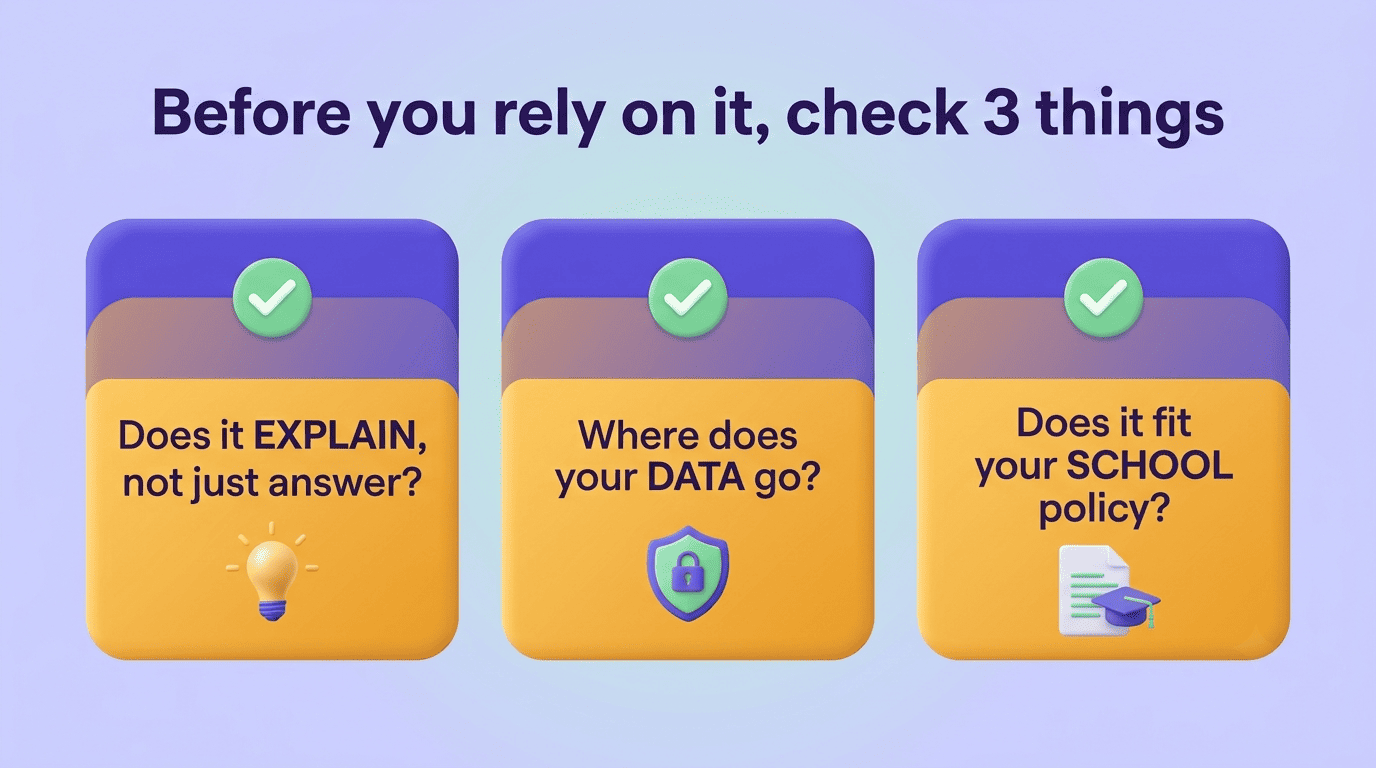
Before picking a tool, check three things in this order:
- Does it actually explain the reasoning, not just deliver an answer?
- What happens to the homework photos and files you upload?
- Does it fit your specific school or class’s policy on AI assistance?
Getting those three right matters more than which tool has the flashiest interface.